
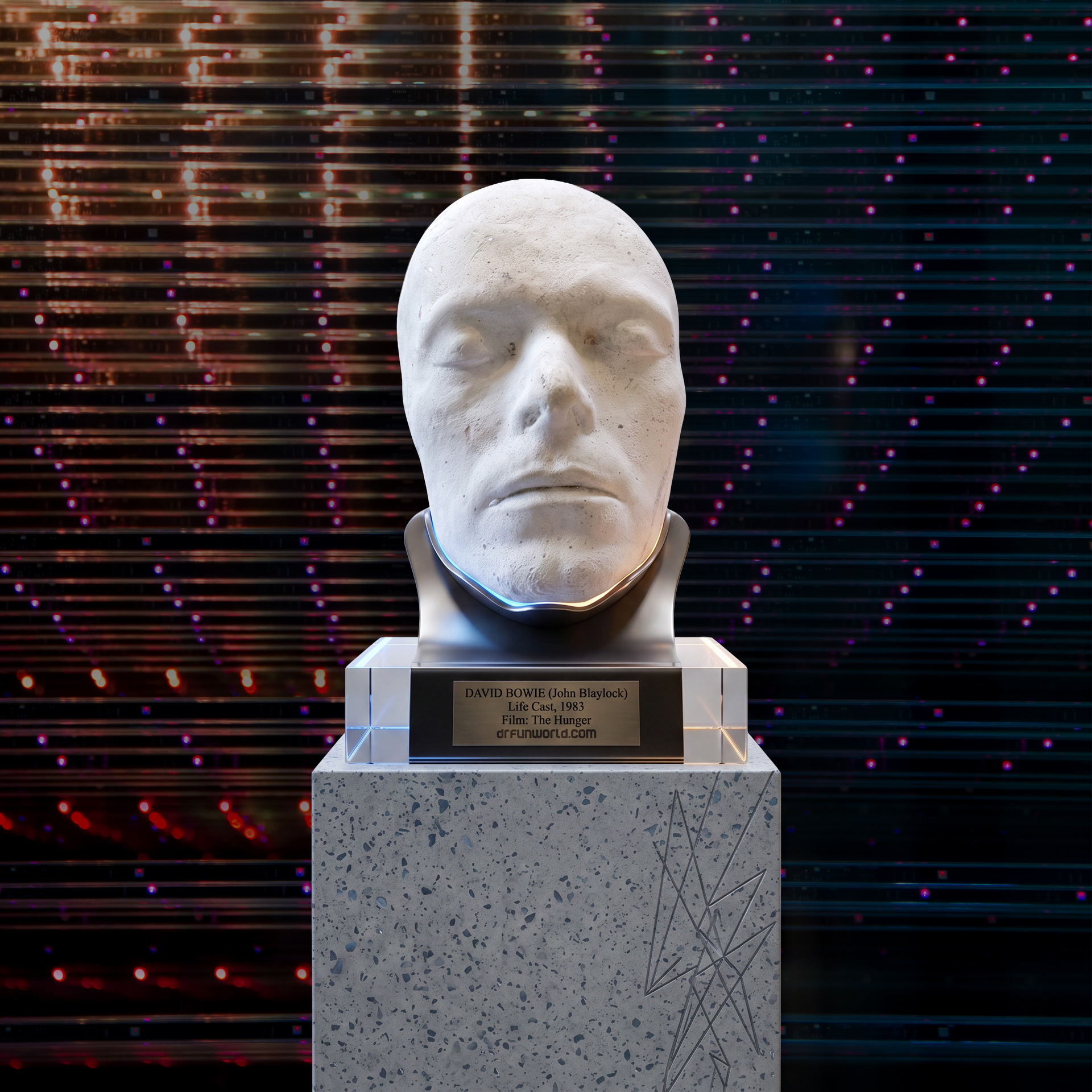
David Bowie Life Cast — The Hunger, 1982/1983
Discover a rare David Bowie face cast associated with The Hunger, the 1983 Hollywood film where Bowie’s image, cinema, prosthetic art, and pop culture mythology converge.
Description
This cast presents the face of David Bowie not as a publicity image, album persona, or staged portrait, but as a direct sculptural trace of the performer at the point where music, cinema, identity, and transformation meet. Created from a mould associated with Bowie’s screen work, the object belongs most convincingly to the production context of Tony Scott’s 1983 film The Hunger, in which Bowie played John Blaylock, an elegant and doomed vampire whose body rapidly collapses from youth into extreme age.
Unlike a photograph, a life cast records physical presence through contact. It preserves structure, proportion, skin surface, facial tension, and stillness with a degree of intimacy that no camera can fully reproduce. In Bowie’s case, this carries unusual significance. His artistic career was built around the deliberate construction and dismantling of personas: Ziggy Stardust, Aladdin Sane, the Thin White Duke, the alien, the aristocrat, the actor, the mask. A cast of his face is therefore more than memorabilia. It is an object about identity itself — the face before performance, and also the face prepared to become another figure.
The connection to The Hunger gives the piece particular cultural weight. The film stands at the intersection of post-punk atmosphere, gothic cinema, 1980s visual style, fashion, desire, decay, and celebrity mythology. Bowie’s character, John Blaylock, is introduced as refined, seductive, and immortal, only to become the subject of one of cinema’s notable aging transformations. For that process, the face had to be studied, replicated, and transformed through sculptural and prosthetic techniques. The cast therefore belongs to the hidden technical world behind the image: the workshop, the mould, the make-up test, the prosthetic appliance, the transformation before the camera.
As an art object, the cast has a powerful duality. It is both quiet and theatrical. Its surface is neutral, yet its cultural charge is immediate. It does not show Bowie performing, singing, or posing; it shows the architecture from which those images were made possible. The closed stillness of the face invites the viewer to consider Bowie as material, icon, subject, and myth. It is a rare kind of object: intimate enough to feel human, but distant enough to feel archaeological.
Within The Gallery, this cast should be presented as a sculptural document from the wider history of pop culture and cinematic transformation. It connects music to film, performance to object, and celebrity image to physical evidence. It is not merely a portrait of David Bowie. It is a record of the process by which Bowie’s face, one of the most recognizable visual instruments of twentieth-century popular culture, was copied, studied, and prepared for metamorphosis.
This piece is one of a hundred that belongs to the world of rare cultural artifacts because it preserves the threshold between the person and the persona. Bowie spent his career turning identity into art. David Cabrera’s artwork also overlaps with this casting since he originally paints each casting differently.
*** Note: Shipments are considered ONLY within the United States, Mexico and Canada. For Shipments to other countries we will contact you for details.
Additional information
| Format | CD, Vinyl |
|---|


Reviews
There are no reviews yet.